

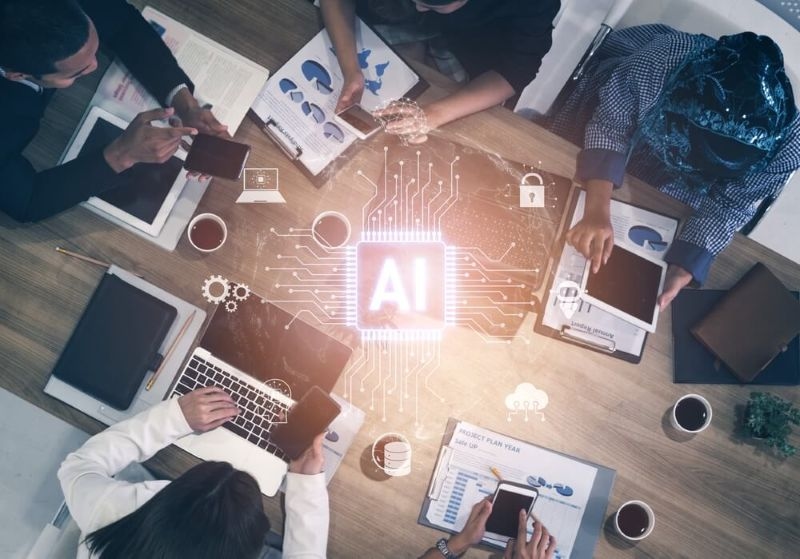
AI isn’t just something you see in presentations or tucked away in research labs anymore. It’s weaving itself into how teams actually work—changing the way people make decisions, collaborate, and even sell. These days, companies don’t just use AI; they actually adapt their processes around it. Sometimes the shift is pretty subtle, like getting faster replies or generating reports automatically.
Other times, it’s huge—entire processes run on their own, or AI handles predictions instead of people having to guess.
Across industries, you see the same story: companies get tighter with budgets, move faster, cut down on delays, and let machines handle more of the everyday details. This change is steady, but it’s not flawless. And it's not slowing down—it just keeps building on itself.
In this blog, we will look at AI-driven innovation, automation shifts, smart systems, and how AI trends are transforming business operations in real settings.
AI Innovations are not just tools anymore; they sit inside decision loops. Companies use them to predict demand, reduce manual workload, and sometimes replace entire micro-processes that used to take hours.
They appear in places people ignore at first. Email sorting, lead scoring, and inventory forecasting. Then, suddenly, they expand into pricing models or customer behavior prediction. It doesn’t always feel dramatic. But impact is there.
And it keeps spreading sideways into departments that were never “tech-heavy”.
Growth used to depend on more manpower or more time. Now systems decide faster than teams sometimes. Not always perfect, but quick enough to change outcomes. Businesses using AI Innovations often report less friction in decision cycles.
There is a strange shift here; strategy is not only human-led anymore. It is shared with models, dashboards, and prediction engines.
Artificial intelligence growth is not linear. It comes in jumps. One update changes ten workflows. Another removes manual steps nobody questioned before.
Earlier, AI stayed in IT or analytics teams. Now it sits in marketing, logistics, customer service, and even compliance. That spread matters more than people expect.
Marketing teams use it for content variation. Logistics uses it for route planning. Compliance uses it to detect anomalies. Each use case looks small alone, but together they change the structure.
And companies start relying on it without fully noticing.
Here’s where it gets a little complicated. People are still calling the shots, but machines sort through most of the information first. Reports come already analyzed, and risks are flagged ahead of time.
It’s easy to see how AI is changing the way businesses work. Decisions don’t come straight from the data anymore—they arrive after algorithms have done their thing. Some teams put all their faith in the results. Others don’t trust it and go back over everything, just to be sure. Most land somewhere in the middle.
Automation tools are less about replacing jobs and more about removing repetitive drag. But yes, changes in roles happen anyway.
Most automation is invisible. It runs without attention until it breaks or saves time.
It doesn’t look complex on the surface. But under it, systems talk to each other nonstop.
Something’s changed. These days, customer onboarding, basic support, and even routine approvals barely involve people at first. Everything moves faster, but you lose some of that human oversight. Some companies catch on fast, while others have a tough time trusting those automated processes.
Automation isn’t just lending a hand anymore. It’s actually standing between teams and the results they’re chasing.
Smart systems combine data, prediction, and action. They don’t just show reports; they suggest or execute next steps.
These systems watch how people use them—what they do, when they do it, how well things turn out. From there, they tweak their suggestions or methods. Bit by bit, every business gets a version that fits a little better. It’s not perfect, but it’s smart enough to feel like it’s paying attention.
Inventory rises or falls depending on what people actually want. Ads switch up as your customers change their habits. Prices jump or drop with the market. You might not notice it happening, but the system never stops watching and adapting.
And this is where businesses feel both control and loss of control at the same time. A strange balance. Smart systems quietly push organizations toward a reactive strategy instead of static planning.
A few patterns keep repeating across sectors, similar to what industry reports and discussions (like recent LinkedIn analyses on AI-driven operations) highlight.
None of this feels like a single revolution. More like stacked updates. And companies that adapt early usually don’t look dramatically different day-to-day, but their speed gap becomes noticeable over time.
AI is not a single tool anymore; it is a layer sitting under most business activities. From innovation to automation tools to smart systems, everything connects back to speed and prediction. The real shift is subtle; work doesn’t disappear, it just moves into different hands, often machine-assisted ones.
Some businesses adopt fast, others slow. But direction is already set. Processes are tightening, decisions are accelerating, and systems are learning continuously without pause.
Organize, share, and collaborate effortlessly with GPTDrive —your AI-enhanced workspace that just works http://gptdrive.com/
Not really. It’s great at clearing away repetitive tasks, but it doesn’t replace everything. People still need to step in for anything that needs real judgment or personal touch—especially with clients or oddball situations that automation just can’t handle.
To some extent, yes. You can run certain AI tools offline, but most of the smart, modern ones lean on the cloud for fresh data, updates, and flexibility. Offline options usually feel a bit limited and are slower to improve.
It’s actually not that pricey to get started. You’ve got plenty of options—some let you dip your toe in or just pay as you go. But here’s where the real investment comes in: working AI into your daily routine.
No, not really. The biggest wins usually show up in industries that already keep their data neat and digital. If you’re in a field where data is spread out or messy, results aren’t as predictable, and progress can be slower.
This content was created by AI